The National Identity Management Agency, NIMC is pursuing a campaign to enroll school-age children and infants into Nigeria’s National Identification Number (NIN) system. This effort is part of a broader push to ensure every Nigerians and legal residents have a foundational identity aligning with the United Nations Sustainable Development Goal of providing legal identity for all by 2030.
As of December 2025, about 127 million people have been issued with NINs. With Nigeria’s population estimated at roughly 242 million people about 42 per cent of this population are under the age of 15, which covers school age children.
To meet the set target of enrolling 95 per cent of Nigerians by 2026, the Commission would need to register at least 3.3 million people monthly, and more than 120,000 daily. This has led to the decentralisation of registration centres to the ward level.
However, this initiative has largely overlooked the schedule of students who are expected to be in school during the same working hours NIMC officials and offices operate.
Currently, NIN enrollment takes place at NIMC offices from Monday to Friday between 8 a.m. to 4 p.m., in line with civil service working hours. Whereas most schools begin by 7am and closes between 2 p.m. or 3 p.m., making it difficult for students to complete their registrations without missing classes.
As a result, many students skip school entirely for NIN enrollment, sometimes spending whole school days in long queues.
“It is Impossible to do it at the NIN office after school,” said Opeyemi Paul, a senior secondary school student. “By the time you get there after school, they would have shared the numbers to the people they want to attend to. So, when you come by that time, they will still ask you to come back.”
Students in queues instead of classrooms
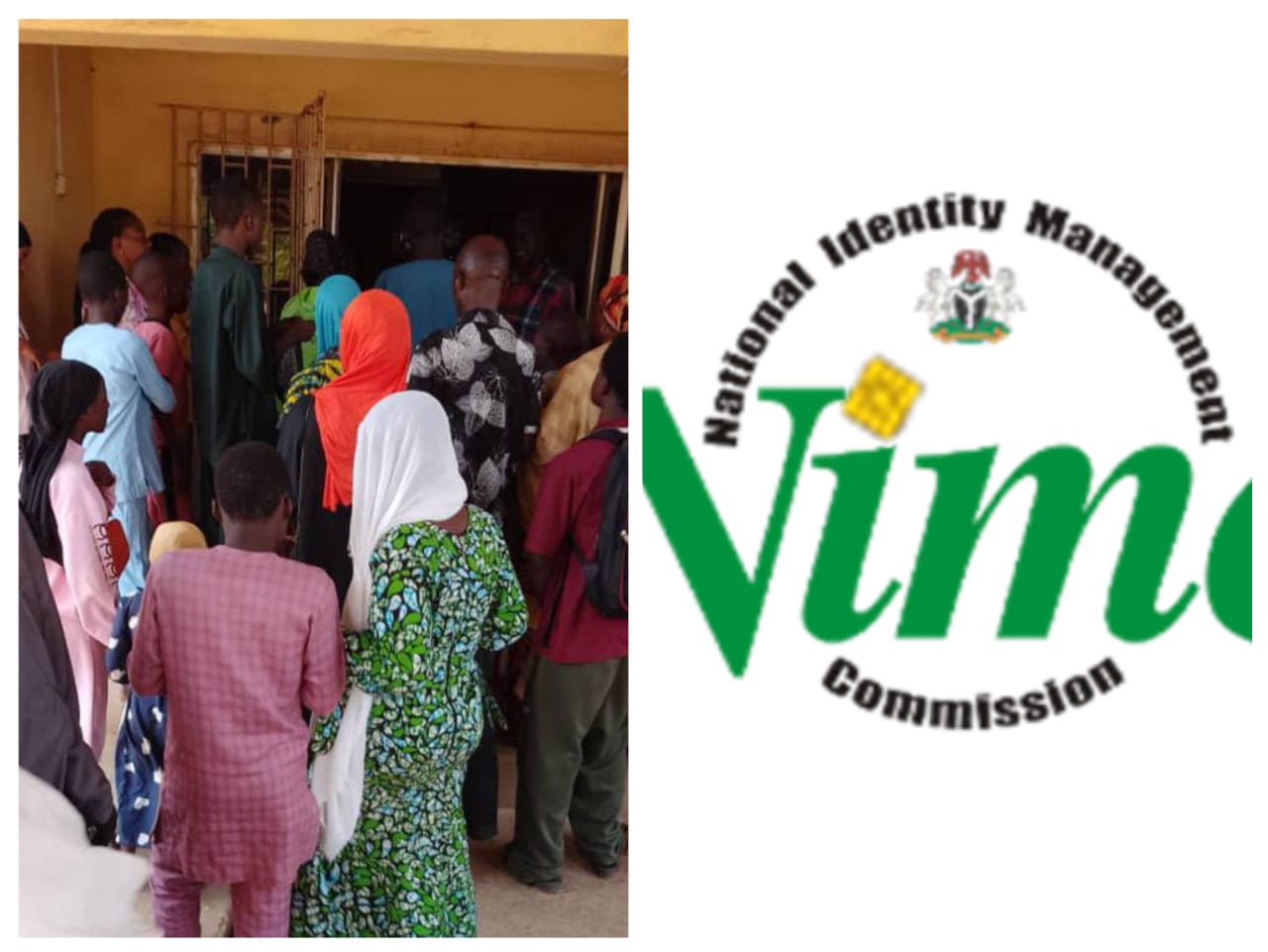
On Thursday morning, January 15, 2026, at NIMC head office in Kwara State, residents gathered to enroll for NIN. Among them were school-age children who should be in their classrooms, but are instead on queues.
One of them, is a 14-year-old secondary student who identified herself as Maryam, came to the centre with seven other children, which included her younger ones and neighbours.
“I came yesterday, but I could not wait because of the crowd. So, I came back today around 6:30am and I picked numbers, so I went back home to bring them[other children] in Keke Napep,” she explained.
After each child completed registration, they waited under the tree opposite the registration hall to wait for the others. It was about 2 p.m. before they left the Commission office premises.
“They will go to school tomorrow,” Maryam said. “If we don’t do it like that, they may never get to do it anytime soon. And you know the government can come up with any law tomorrow. Registration is free here but it costs money to do it elsewhere. And my parents trust this place because it’s the State headquarters.”
Maryam was not the only secondary school student at the centre, there were many others waiting for their turn, some of them fielding calls from their parents or guardians asking why they had not returned home.
“It would soon be our turn. They are calling people according to numbers,” a teenage boy speaking loud enough for people close by to hear, reassured someone on the phone.

Parents were also present. Some accompanied their children, while others dropped them off before heading to work.
One parent, Fausat Abidemi, said she briefly left her children in the queue to sign the office attendance register at her office. She recounted how some children were sent back home to collect his parents’ NIN after waiting in the queue for over three hours.
“We got here early but they had not started. After picking numbers, I went to my office to mark the register. By the time I got back, they had started. Children who did not have their parents’ NIN were asked to go home and bring it. My son was driven out of the queue twice for the same reason but he kept going back until the officer did not notice him again,” she explained.
Another resident, Isiaq Hammid, came with his two children, one in primary school and the other in pre basic. According to him, it was his third time.
“On the first day, I came alone to make an inquiry about the process. The second time, I came with my children but it was not early enough so we could not do it. This is the third time. Since about 9 a.m. when we arrived, we finished at 4 p.m. Our number was 97,” he said.
Inside the enrolment hall, there are about thirty registration cubicles, however, only four of them were being used as at the time of visit.
Why NIN enrollment matters to students
NIN is Nigeria’s foundational identity system designed to enable inclusion, access to services, and participation in the country’s emerging digital public infrastructure (DPI) system.
For students, the number is increasingly essential. It is required for registering for major examinations such as the West African Examinations Council (WAEC) exams and the Joint Admissions and Matriculation Board (JAMB) examination. It also enables access to scholarships, government grants, education loans like NELFUND, and international opportunities such as the newly introduced UNESCO Read and Earn Federation.
As of February 23, 2026, a total number of 983,706 students had benefitted from NELFund across 36 States and Abuja. NIN is a basic identifier to qualify for this initiative.
In 2019, the Joint Admissions and Matriculation Board, JAMB, announced a policy change. Beginning from 2020, students were now required to register for the examination using their NIN. WAEC also commenced use of the foundational Identity number for registration in 2022.
At a meeting with stakeholders, the JAMB Registrar, Professor Isiaq Oloyede said that the decision approved by the Federal Ministry of Education, was due to multiple applications, impersonation and other forms of examination malpractices.
“We don’t even require the name of the candidate, we just want the NIN. We will then do the needful to pull the data of the candidate and the process will go on from there,” Oloyede said.
In a statement, JAMB affirmed that the use of NIN had helped in eliminating multiple registrations, impersonation and other malpractices associated with examinations.
The rise of paid enrollment shortcuts
Although enrollment at NIMC offices is officially free, many residents say they resort to private accredited centres to avoid the long queues and rigid hours.
These centres, run by accredited institutions and individuals, charge service fees and work longer hours.
Residents reported paying as much as ₦4,000 for enrollment and a plastic card, while paper registration reportedly costs around ₦2,000.
“It’s better than going to their office in Ilorin. It is far from home,” said Abimbola Tijani, who enrolled her daughter at a private centre ahead of the UTME exams.
Another resident, Ahmed Abdulrahman said his children registered in school. “We received a message that they want to come to my children’s school. They asked parents who want their children to enroll to pay N1,000 per child. I paid for the three of them. They gave each of them a form that we filled indicating their names, date of birth, state of origin and others. They also requested for my NIN,” he explained.
Requirements and early enrollment burden
NIMC requires children from aged 0 to 15, to enroll with the parent/guardian’s NIN, a registered phone number of parents or guardian, registered birth certificate or statutory age declaration. Minors must be accompanied by at least one of the parents or a guardian.
However, at the attainment of 16 years, such a child is expected to go for an NIN upgrade from the minor category (ER) to the adult category (CR).
The Commission said a text will be automatically sent to the phone number used by the applicant for enrollment, immediately when they turn 16.
The Commission has also expanded early enrollment. Reports indicate that about 14 million babies have already been issued NINs at birth.
Stakeholders want NIN enrollment brought to schools
NIMC is not unaware of the challenges with NIN enrolment hence its move to the ward level to attract more enrolment. However, observers say unique requirements of various segments of the society must be identified and leveraged for the commission to meet its target.
According to an educationist, Olufemi Idowu, students are not finding the registration process easy owing to the fact they have to miss school to enroll, wait till its holiday or mid term break and wait till their parents are chanced to accompany them.
“During the recent registration for WAEC, some students had to take permission to be away from school to register for NlN. Some were able to complete the process early and return to school, some could not. There should be a school focused enrolment system,” he said.

Also, the Chairman, Nigeria Union of Teachers, NUT, Kwara State chapter, Comrade Yusuf Wahab Agboola said students should not be made to go for NIN enrolment when such services could be brought to them. Comrade Agboola said enrolment for WAEC/BECE are done within the school premises by trained teachers.
”When exams are approaching, they (WAEC) usually invite schools to send representatives. The representatives are trained on how to register the students’ biometrics on an online portal, and required documents. This has been going on smoothly. NIMC can also use this approach rather than allow students and their parents/guardians to spend valuable time waiting for enrolment,” he said.
In its 2025 report, the Presidential Enabling Business Environment Council, PBEC ranked NIMC amongst the ”poorest-performing government institutions in the country,” scoring zero per cent in efficiency compliance resulting in users often facing “long delays, misinformation and avoidable bureaucratic barriers.” Stakeholders expect that the result would propel NIMC to review its operations and tailor its services towards specific needs of people for improved enrolment outcome.
NIMC Kwara Reacts
In a reaction, the NIMC Kwara State Coordinator, Abubakar Muhammed Idris explained that the ongoing ward level enrollment presents an opportunity for students to enrol at a place closer home. Mallam Idris however said plans are underway to collaborate with the State Government on students’ enrollment.
“We had a meeting with the Permanent Secretary, Ministry of Education and Human Capital Development in January. Our conclusion then was that they should draw up modalities for us. Give us the list of all secondary schools within Kwara State. When she (the permanent secretary) came to our office, we agreed, and a list of schools was given to us. She promised to set up a committee from the Ministry. We would now add our staff into that committee and come up with a schedule in collaboration with the State Government,” he said.
Mallam Idris who spoke through the NIMC State Admin Officer, Ahmed Adeoye, however urged interested private schools to write the Commission for on-site registration of students to avoid extortion.
This report is produced under the DPI Africa Journalism Fellowship Programme of the Media Foundation for West Africa and Co-Develop