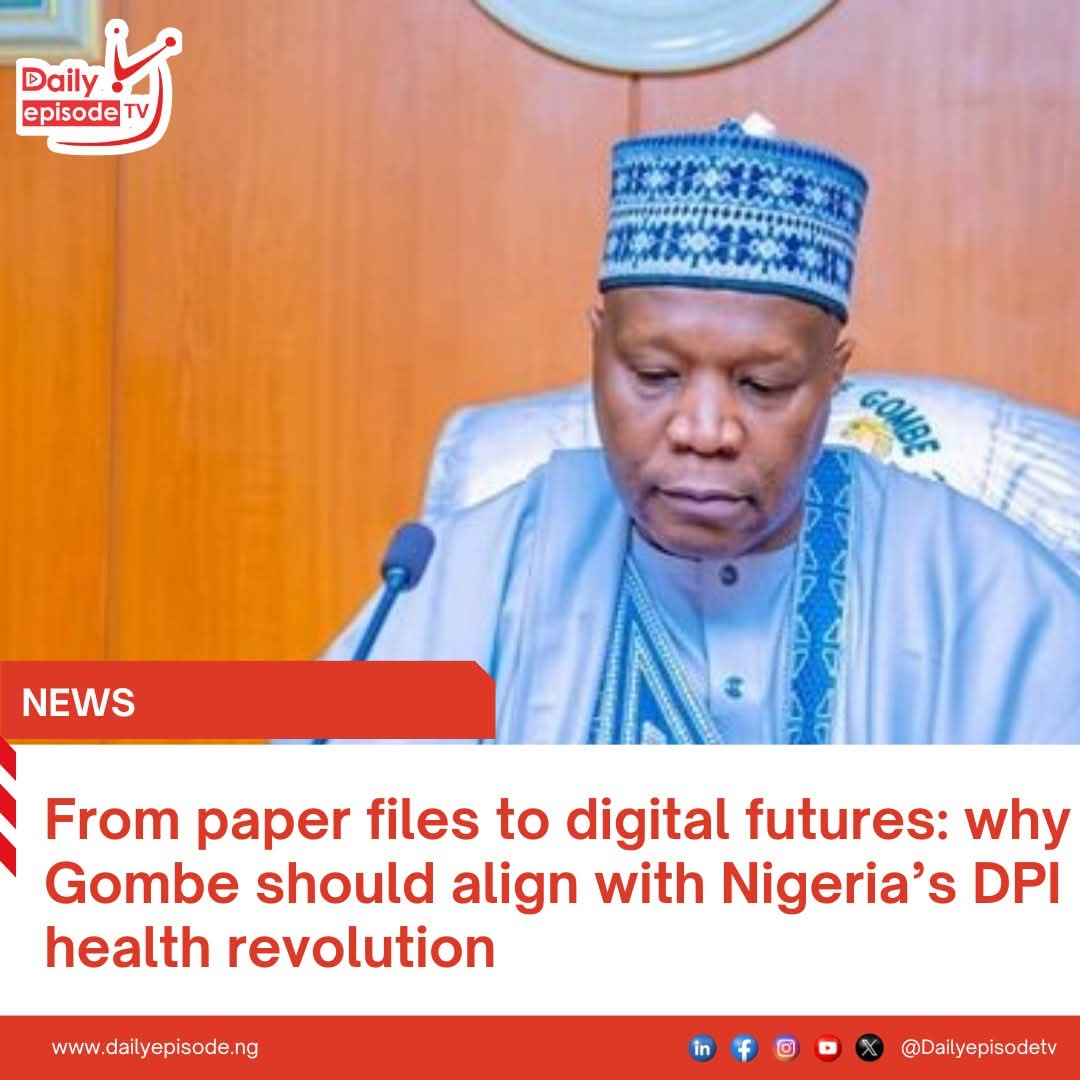
In Gombe State, patients’ medical records have largely been stored in paper files, a system that slows healthcare delivery, frustrate workers and often puts patients at risk.
Across Nigeria, however, the health sector is entering a new phase shaped by Digital Public Infrastructure (DPI). As the country builds foundational digital systems designed to connect services nationwide, Gombe stands at a critical juncture to modernise its health records or risk being left behind.
The cost of paper-based system
For decades, patients in Gombe hospitals have navigated a cumbersome system. Retrieving files can take hours. Booking appointments requires physical presence. Patients often recount their medical history repeatedly before receiving treatment.
To beat administrative delays, patients often arrive at health facilities very early just to secure a place in line while records staff search for their files.
When files go missing – not an uncommon occurrence- , patients are frequently required to repeat laboratory tests, increasing costs as well as causing delay.
Patients’ experiences
Aishatu Sani, a resident of Pantami Quarters, described the hardship she faced after relocating to another community following marriage. Her previous medical records could not be accessed at the new hospital.
“Even with the card, sometimes we suffered before they finally retrieved the file,” she recalled. “Sometimes they ask when last a patient visited before they can access it.”
She said repeated questioning about medical history and duplicate tests often worsen patients’ conditions.
Similarly, Abdullahi Isah Muhammad faced the same difficulties caused by the lack interoperable systems that allows for shared medical records across facilities.
“I suffered when I traveled out of Gombe and fell ill. I had to undergo new laboratory tests because my records were not available,” he said.
He added that the experience left him anxious about falling sick while away from home as his experience in Jigawa State still lingers in his memory.
Like many others, both patients support integrating digital public infrastructure into the state’s healthcare system.
The DPI solution
Integrating DPI into the health system could enable medical personnel to respond to emergencies using prior knowledge from the centralised digital health records.
According to DPI Africa platform, “DPI refers to foundational digital systems—such as digital identity, interoperable data platforms, and digital payment rails—that are built in the public interest and can be reused by governments, private sector players, and innovators.”
In healthcare, “DPI provides a shared digital backbone that allows health services to communicate with one another.”
This includes national digital ID systems integrated with health data ranging from insurance records to medical histories, enabling secure information sharing among hospitals.
Nigeria’s digital transformation is accelerating. The country’s DPI vision is built around interoperable digital identity systems, data exchange platforms, and secure payment rails that serve both public and private sectors.
In healthcare, this approach is being operationalised through the 2024 National Digital Health Initiative (NDHI) under the Federal Ministry of Health. The initiative ia anchored on three core components which are: – an interoperable digital health services network built on open and modular systems; a Health Claims Exchange to improve transparency, reduce fraud, and support data-driven financing and a Health Information Exchange enabling secure data sharing across public and private facilities nationwide
These systems are designed to connect federal, state, and local health services, ensuring that patient data follows the patient, not the paper file.
Last year, the minister of state for health and social welfare, Iziaq Adekunle Salako describes the NDHI as a decisive moment in Nigeria’s DPI’s goal.
“For too long, our health system has suffered from fragmented service delivery and poor data infrastructure,” Salako said. “The NDHI offers us a chance to overhaul the digital foundation of healthcare in Nigeria and ensure data, technology, and people are at the center of decision-making and care delivery.
If properly implemented, this architecture would allow a doctor at General Hospital Billiri to securely retrieve records from Gombe Specialist Hospital within minutes, reducing duplication and accelerating treatment. Thereby increasing the potential to help Gombe and Nigeria build a healthcare system that is more accessible, efficient, and equitable regardless of geography.
Why it matters for Gombe
Gombe’s health sector faces persistent challenges, low insurance coverage, inadequate funding, workforce shortages, rural–urban disparities, and weak policy implementation. A state-aligned digital health record system, integrated with Nigeria’s broader DPI architecture, could transform service delivery by improving continuity of care, reducing duplication, strengthening disease surveillance and promoting financial transparency.
Crucially, Nigeria’s DPI roadmap prioritises interoperability, the seamless integration of systems across federal, state, and local levels. As outlined in the federal government’s plan to build unified digital services by 2027, public sector platforms are expected to connect securely and eliminate data silos.
For Gombe State, this means that any state-level digital health system would be designed to integrate with national databases, contributing to a cohesive, nationwide health information ecosystem by 2027.
Speaking on the DPI framework, the Minister of Communications, Innovation and Digital Economy, Bosun Tijani, said it “will also ensure that technology applications in government are designed and operated without silos, while recognising the responsibilities and mandates of various ministries, departments, and agencies of government across all tiers of government in Nigeria.”
Addressing data privacy concerns
As Nigeria prepares for a full DPI rollout by 2027, experts have raised concerns about data privacy and protection. Questions remain about who can access sensitive health information in a country where data protection practices remain inconsistent.
Digital governance specialist Hassanat Oladeji said successful digital public infrastructure depends on three principles: privacy-by-design, security-by-design, and accountability-by-design.
Public trust is essential, she added. When citizens fear their personal data is unsafe, they are less likely to adopt digital platforms or share accurate information.
The Nigeria Data Protection Commission anchors Nigeria’s data protection regime through a layered regulatory framework. At its core is the Nigeria Data Protection Act (NDP Act) 2023, which serves as the country’s primary legal foundation for privacy, data rights, compliance obligations, and enforcement.
The Act builds on earlier instruments such as the Nigeria Data Protection Regulation (NDPR) and its Implementation Framework, consolidating them into a stronger statutory structure. The General Application and Implementation Directive (GAID) provides detailed operational guidance, translating the Act’s provisions into practical compliance requirements.
Together, these instruments form the backbone of Nigeria’s modern data governance architecture.
This report is produced under the DPI Africa Journalism Fellowship Programme of the Media Foundation for West Africa and Co-Develop.