At 30, Abosede Pharez-Okeke was shot during an ambush on the road to Makurdi, Benue State. Bleeding and barely conscious, she was rushed to a hospital where doctors removed the bullet, cleaned the wound, and placed her under observation.
For a moment, it seemed the worst was over.
But two days later, something changed.
“A strange smell started coming from the wound,” she recalled. “At first, I ignored it. I had been shot. I thought maybe it was part of the healing.”
It wasn’t.
As the smell worsened and confusion grew among hospital staff, Abosede was transferred to the Federal University Teaching Hospital, Lafia. There, surgeons reopened the wound and discovered a piece of surgical gauze left inside her body.
“They showed it to me,” she said. “They forgot it inside.”
The gauze had begun to decompose, infecting her tissue and prolonging her recovery.
Yet beyond the medical error itself, another question lingered: what happens after harm occurs?
Abosede said she could not verify who was involved in her care, whether they were properly licensed, or whether similar complaints had been recorded elsewhere. Like many patients, her ability to seek accountability was limited not just by the incident but by the system around it.
That gap is not unique.
When Harm Happens, Reporting Is the Hardest Part
In 2017, journalist Monikanola Ogidan encountered a different kind of hospital error after delivering her twins.
“They brought another person’s drugs to me,” she said. “Thank God I had mastered my medications. I knew immediately those drugs were not mine.”
When she raised the alarm, the situation escalated.
“The nurse shouted at me. That was when I realised she had already given my drugs to someone else.”
Like Abosede’s case, the incident raised troubling questions: If harm had occurred, how easy would it have been to report the practitioner formally? Would Ogidan have been able to verify whether complaints already existed? Would regulators have had a digital trail to track the incident?
In Nigeria today, the answers remain uncertain.
These stories resurfaced with renewed urgency after the death of Chimamanda Ngozi Adichie’s 21-month-old son, which prompted an outpouring of grief and accounts of negligence and inadequate care.
Adichie and her husband, Dr Ivara Esege, have begun legal action against the hospital, accusing it of medical negligence.
For decades, the state of Nigeria’s public health sector has made national headlines with accounts of underpaid doctors carrying out surgeries by candlelight in the absence of power supply, patients paying for gloves and other missing basics, dilapidated facilities and nonexistent research departments. Those who can afford to seek care abroad typically do so.
What ties these failures together is not only underfunding but the absence of enforceable, real-time accountability.
From Individual Errors to System Gaps
These two cases point to a broader structural issue: not just the occurrence of medical errors, but the difficulty in verifying practitioners, reporting harm, and tracking accountability across the health system.
This challenge extends beyond doctors alone.
In both cases, the harm described was linked to nursing care, whether in the management of surgical materials or the administration of medication. Yet public discussions around verification systems often focus narrowly on doctors, leaving out other critical actors in the care chain.
From Individual Errors to System Failure
These cases point to a deeper structural issue: not just that medical errors occur, but that they are difficult to track, verify, and act upon after they happen.
Kehinde Olomiye, former chairman of the Ondo State chapter of the Nursing and Midwifery Council of Nigeria, said systems do exist, but access is limited.
“They have databases. Each council has it, and even hospitals,” he said. “But it is not something the public can easily use.”
He explained that while digital portals now exist for verifying practitioners, they are not universally accessible and are often tied to internal processes.
“Each hospital has a complaint box,” he added. “There is also an app, but only some people can access it.”
This creates a bottleneck. Accountability depends on institutional processes rather than patient-driven reporting.
As a result, many incidents never move beyond the hospital where they occurred.
The Verification Gap
This limitation extends beyond nursing.
The Medical and Dental Council of Nigeria (MDCN), which regulates doctors and dentists, maintains a register and an authentication portal used by practitioners. However, what remains unclear and inconsistently documented is the extent to which this system is accessible to employers, patients, or the public for independent verification.
In practice, verification is not seamless.
Patients cannot easily check, in real time, whether a practitioner is licensed, suspended, or under investigation. Instead, the process often requires formal requests or institutional mediation.
A similar pattern exists in laboratory services.
Although the Medical Laboratory Science Council of Nigeria (MLSCN) regulates laboratories and practitioners, its public-facing verification tools have at times been inactive or inaccessible, according to industry sources.
The implication is systemic. Across doctors, nurses, and laboratory professionals, verification exists, but not in a way that is consistently open, real-time, or easy to use.
While the Council has an online registration portal for doctors, there is no functional, public-facing verification platform where patients can independently confirm a practitioner’s status, whether the person is licensed, suspended, or under investigation.
Verification still depends on formal written requests, and the core register remains predominantly paper-based, supported only by a limited internal digital database accessible to MDCN staff and select government agencies.
The Laboratory Gap Shows the Same Pattern
The problem is not limited to doctors.
The Medical Laboratory Science Council of Nigeria(MLSCN) regulates laboratory scientists and accredits diagnostic laboratories. In principle, this includes maintaining records of licensed professionals and approved facilities.
However, its public verification portal has at times been inactive or inaccessible, leaving patients unable to confirm whether a laboratory is accredited or whether a practitioner is authorised to practise.
This creates a broader accountability gap: not only for doctors, but also for nurses, laboratory personnel, and facilities, all of whom form the chain of patient safety.
When any link in that chain becomes unverifiable, enforcement weakens.
The Medical Laboratory Science Council of Nigeria (MLSCN) verification portal is primarily used for verifying accredited, licensed practitioners to ensure they are registered and authorized to practice. While MLSCN handles laboratory accreditation, the main online portal (e-licensure) focuses on practitioner licensure, while separate lists exist for registered/approved laboratories.
A check by this reporter also revealed that the Medical Laboratory Science Council of Nigeria’s verification portal has remained dormant, further compounding accountability gaps across the health sector.
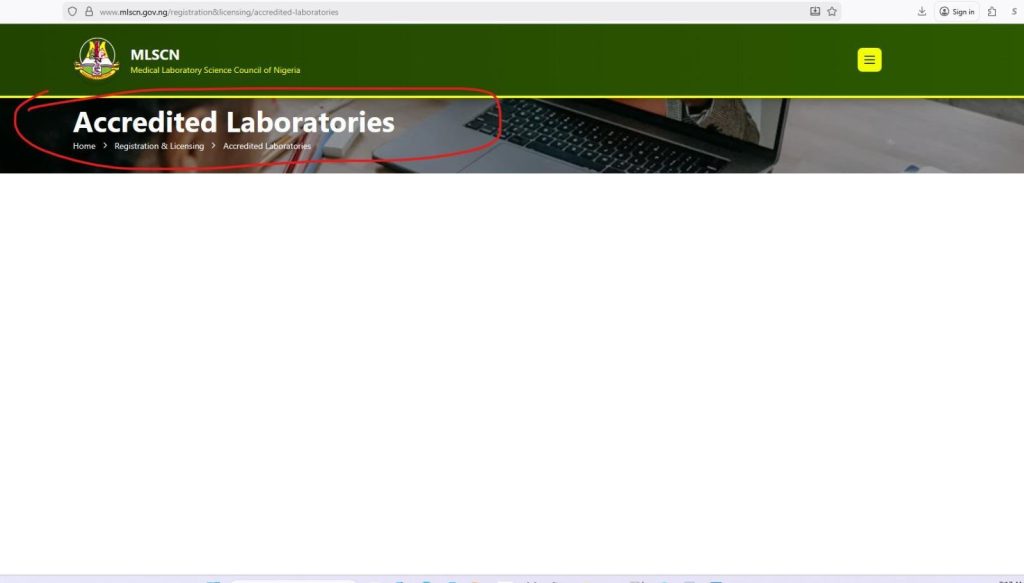
A screenshot of the Medical Laboratory Science Council
A senior medical laboratory scientist, who spoke on condition of anonymity, said the Medical Laboratory Science Council of Nigeria (MLSCN) is responsible for regulating laboratories and maintaining accreditation records, but access to such information remains limited.
“For MLSCN, that is a government institution. It should be public,” the scientist said. “It should be public, except it’s not available to me.”
According to the scientist, parts of the council’s online accreditation records were previously accessible but may have been taken down during a recent review process.
“Last year, they were trying to reactivate and adjust the criteria for accredited labs in Nigeria. Probably that was why they had to move that section of the site down to upgrade,” the source said.
“If there’s a new criteria, it implies they have to pull it down. They are probably trying to upgrade to that direction,” the scientist explained.
In the absence of a central digital platform, verification of accredited laboratories often relies on physical indicators.
“Any lab that is accredited usually has a sign showing the council’s logo in front of the facility,” the source said. “That is what authorities use to identify accredited labs.”
However, the scientist acknowledged that this system has limitations, particularly in an environment where unregistered facilities operate.
“There are fake laboratories now, where they do all sorts. There are fakes everywhere,” the source warned.
The official noted that a comprehensive, publicly accessible digital database of accredited laboratories is still lacking.
“I’m not sure there’s a digital platform where you can just access all those labs at a go,” the scientist said.
Despite this, the source expressed optimism that the council may restore public access once its review process is completed.
“Whoever has that data will have to release it on that site as soon as possible,” the scientist added. “It was there before.”
Why This Is a Digital Public Infrastructure Problem
At its core, the issue is not simply about regulation; it is about infrastructure.
Digital Public Infrastructure (DPI) refers to foundational digital systems that enable societies to function efficiently and transparently at scale.
In healthcare, this includes systems that allow patients to verify practitioners, hospitals to screen staff, and regulators to track complaints and disciplinary actions in real time.
Crucially, DPI does not require a single central database. Modern systems are often federated, allowing different institutions to maintain their data while sharing trusted, interoperable information.
Nigeria’s current system falls short of this model.
Without reliable, always-on digital registries and reporting platforms, accountability mechanisms become slow, fragmented, and difficult to enforce.
Unlike Nigeria, several countries operate public, DPI-aligned medical registers that allow citizens to verify the licensing status of health practitioners.
In the United Kingdom, the General Medical Council (GMC) maintains a comprehensive, up-to-date online register that is open to the public. The database allows anyone to search by a doctor’s name or GMC reference number to confirm licensing status and view whether a practitioner holds a current licence to practise. The register also covers physician associates and anaesthesia associates.
Similarly, Australia operates a national public register through the Australian Health Practitioner Regulation Agency (AHPRA). The online database lists all registered health practitioners across 15 regulated professions, enabling the public to verify credentials and registration status nationwide.
New Zealand also runs a transparent system through the Medical Council of New Zealand. Its public register allows users to check whether a doctor is currently registered and authorised to practise in the country, alongside other professional details and qualifications.
In Switzerland, the Medical Professions Register (MedReg) provides public access to practitioners’ personal details, recognised diplomas, and licensing information.
India operates a comparable system through the National Medical Commission (NMC), which maintains a national online register accessible via a public portal for verification of registered medical practitioners.
These systems contrast sharply with Nigeria’s regulatory framework, where access to up-to-date information on licensed medical practitioners remains limited, raising concerns about transparency, accountability, and patient safety.
“Regulation Exists, But Enforcement Is Delayed”
DPI frameworks emphasise trusted, interoperable, and resilient systems that allow institutions to function safely at scale. In healthcare, a practitioner registry is a foundational DPI layer, comparable to identity systems in finance or civil registration.
Crucially, DPI does not require a monolithic or intrusive central database. Instead, it relies on federated architecture with clear safeguards such as data minimisation, so only necessary professional details are exposed; purpose limitation, restricting use strictly to verification and regulation; role-based access, distinguishing what the public, hospitals, regulators, and courts can see; auditability, ensuring every update, suspension, or reinstatement leaves a digital trail and resilience, so systems do not collapse when portals go offline.
Nigeria currently lacks this layer. As a result, accountability is deferred until after injury, infection, or death.
Dr Francis Faduyile, former President of the Nigerian Medical Association, acknowledged the existing structural weaknesses in medical regulation but maintained that the MDCN acts on reported cases.
According to him, the Council would further strengthen medical practice in the country if given adequate support, questioning the government’s delay in fully empowering the MDCN.
“These are some of the concerns doctors have consistently raised with the government,” he said. “When regulation appears weak, it creates the impression that the profession is unregulated, which is not the case.”
Faduyile explained that once a formal complaint is submitted alongside supporting documents and an affidavit, the Council immediately commences an investigation.
“Within a maximum of two weeks, an investigative team is deployed,” he said. “If wrongdoing is established, the doctor involved may be suspended, and the matter referred to the disciplinary tribunal for appropriate sanctions.”
However, he noted that the justice process is often reactive.
“In cases involving fatalities or serious complications, the key issue is how quickly patients, or their families, can obtain justice,” he said. “While early reporting improves the chances, delays remain a significant concern.”
A System Built to Respond After Harm
Digital health specialist Olayinka Ayeni argues that the problem is not the absence of regulation, but the absence of digital public infrastructure that makes regulation enforceable in real time.
“When there is no central, reliable digital registry for doctors, verification becomes fragmented,” he said. “Hospitals and patients are forced to rely on paper credentials, outdated lists, or institutional assurances.”
Ayeni noted that Nigeria is already seeing the same failure play out in laboratory services.
“Our laboratory verification system has been offline for over two months,” he said. “During that period, there was no reliable digital pathway to confirm whether a lab was licensed or accredited.”
The consequence, he warned, is predictable.
“Accountability only begins after harm has occurred,” Ayeni said. “This allows repeated negligence, silent transfers between facilities, and delayed disciplinary action.”
When Systems Go Offline, Enforcement Collapses
“When a central verification platform goes offline for weeks or months, enforcement effectively collapses, even though the law still exists,” he said.
He stressed that responsibility should not rest on patients.
“Hospitals must be the first line of assurance that every doctor under their roof is properly licensed,” he said. “But hospitals can only verify credentials if reliable systems exist.”
Without resilient, always-on digital registries, he warned, even well-intentioned institutions are left without an authoritative source of truth.
“We end up creating responsibility without tools,” Ayeni said. “And in that gap, patients suffer.”
A System Built to Respond After Harm
For patients like Abosede or Ogidan, the absence of a digital registry may not have prevented the original error.
Journalist Ogidan called for the adoption of digital reporting systems in Nigeria’s healthcare sector, arguing that such tools could improve accountability and service delivery.
“So, of course, if there’s a way to digitally report or if there’s a digital database to give feedback on treatment, I think healthcare workers will sit up,” she said. “If you are a nurse or a doctor on duty and you know that your patient has access to rate your service, you won’t be doing all those things that happen in hospitals.”
Ogidan described digital reporting as a more reliable alternative to the current system, which she said is largely paper-based and prone to inefficiencies.
“Paper can be misplaced. A paper-based system is what is working in Nigeria right now,” she said.
While noting that some private hospitals may already be adopting digital tools, she expressed uncertainty about how widely such systems are used or whether they are standardised.
“For serious organisations, especially private hospitals, many of them are going digital, but I’m not sure how effective or widespread those systems are,” she added.
Drawing comparisons with digital feedback systems used in everyday services, Ogidan said healthcare could benefit from similar models.
“When you use platforms like virtual meeting apps, they ask you to rate the service and explain your experience,” she said. “If you have a digital database in hospitals that captures the care you received—who attended to you, what they did right or wrong—it creates a system of accountability.”
According to her, such transparency could influence behaviour across the health sector.
“By the time all of that is in place, everybody will sit up,” she said.
This report is produced under the DPI Africa Journalism Fellowship Programme of the Media Foundation for West Africa and Co-Develop.