On the outskirts of Kano metropolis, Amina Yusuf has not made a phone call in weeks. Her SIM card was barred after failing to link her National Identification Number (NIN). She does not have a bank account either. When a government-supported cash transfer programme was announced in her local government area, Nassarawa, she was told registration required a valid NIN and Bank Verification Number (BVN).
“I went to the registration center many times,” she said. “They said my fingerprints were not captured. Without NIN, nothing works.”
Across Nigeria, stories like Amina’s are becoming increasingly common, revealing how digital identity systems designed to promote inclusion are in practice, deepening exclusion for millions.
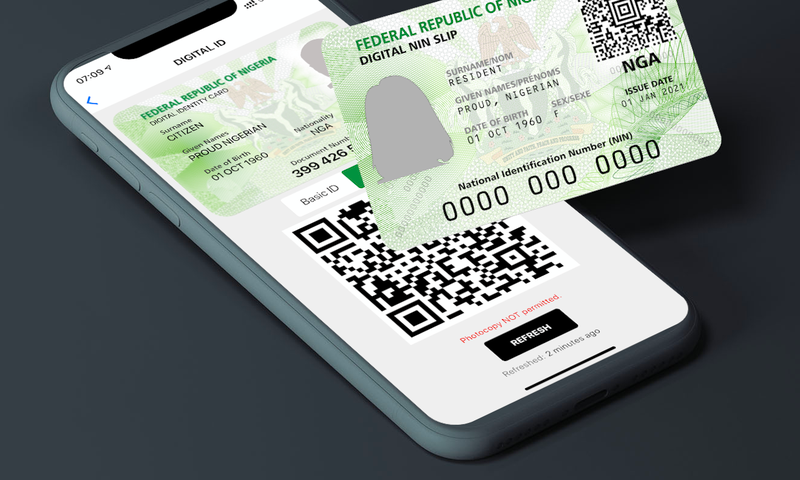
As Nigeria accelerates its transition to digital governance, identity platforms such as the NIN and BVN have become foundational Digital Public Infrastructure (DPI). These systems now determine who can open a bank account, register a SIM card, access mobile money, receive social protection benefits, or qualify for government support.
But in states such as Kano, Katsina, Jigawa, and Bauchi, delayed enrollment, biometric failures, data mismatches, and weak interoperability between identity databases are locking residents out of essential services – often all at once.
When Identity Becomes a Gatekeeper
Digital identity has quietly become the gateway to everyday life in Nigeria. Without a valid NIN, SIM cards are deactivated under mandatory SIM–NIN linkage rules. Without a BVN, banks cannot open accounts. Without either, citizens struggle to access government welfare programmes increasingly delivered through digital channels.
At a NIN registration center in Tashar Rijiyar Zaki, Gwale Local Government Area of Kano State, enrollment officer Abubakar Ibrahim said registration challenges vary from day to day, often depending on technical conditions beyond the control of staff or applicants.
“Sometimes we have network problems from the National Identity Management Commission (NIMC) server, sometimes the issue is from the service providers, and sometimes it is the fingerprint,” Ibrahim said. “Today alone, I registered over 80 people successfully. But there is one man who has been coming here for the past four days from Rimin Gado, and we still cannot capture his fingerprint.”
For such applicants, repeated failed attempts mean wasted transport costs, lost time, and growing frustration, without any guarantee of success.
For many low-income and rural residents, these requirements collide with structural realities. In rural Katsina, a Zainab Musa told WikkiTimes he travelled multiple times to distant enrolment centers, only to be turned back due to faulty equipment or incomplete records. Women, particularly older women engaged in informal trade, said repeated biometric failures often blamed on worn fingerprints kept them from completing registration.
“I’m selling kolanuts,” said Zainab Musa, a trader in Jigawa State. “They say my hands cannot be captured. Without BVN, I cannot open an account. Without an account, I cannot receive assistance.”
What emerges is layered exclusion, identity gaps that block access not to one service, but many.
Banking Without Identity: A Dead End
Banks are legally required to verify customer identity using BVN and NIN-linked data. While aimed at reducing fraud and strengthening financial integrity, the policy has had unintended consequences not only for those without identity, but also for those who already have it.
The exclusion is not limited to those without identity. Even Nigerians who possess both NIN and BVN can still be locked out by additional documentation requirements that many low-income residents are unable to meet.
Auwalu Muhammad, a resident of Rimin Kebe area of Ungogo Local Government in Kano State, said his attempt to open an account with EcoBank failed despite presenting valid identity documents. He explained that he was asked to provide proof of address, such as an electricity bill, but had no acceptable document to submit.
“I went to EcoBank to open an account and I provided my NIN and BVN,” he said.
“But the officer told me I must bring an electricity bill. I explained that I don’t have one because the house I live in is informal and not registered in my name or any family member’s name. They said without proof of address, they cannot open the account for me.”
For Auwalu, the requirement revealed another layer of exclusion embedded within banking processes.
“I have done everything the government asked NIN, BVN but I’m still locked out,” he added. “So what is the point of the digital system if poor people like us cannot meet these extra requirements?”
A staff member of Guarantee Trust Bank at Murtala Muhammad Way branch in Kano, who asked not to be named because he was not authorized to speak publicly, acknowledged the frustration.
“If a customer doesn’t have a BVN or valid NIN, our hands are tied,” he said.
“Even when the person is genuine, the system will not allow us.”
But Auwalu’s experience illustrates how banking access can still break down even after identity requirements are met, particularly for low-income residents living in informal or shared housing arrangements where standard proof-of-address documents are often unavailable.
Disconnected: SIM–NIN Linkage and Loss of Connectivity
Telecom operators, acting on regulatory directives, have enforced SIM–NIN linkage nationwide. While the policy aims to improve security and accountability, it has also led to widespread disconnections.
In Bauchi State, residents told WikkiTimes that SIM deactivation disrupted livelihoods dependent on mobile communication. An online trader in Bauchi Local Government Area, Amina Hassan said she could no longer contact suppliers after her line was barred, while another resident, Mohammed Salisu Bala said his family stopped receiving mobile money remittances from relatives.
A grain seller at Dawanau market in Kano, Danjummai Ibrahim said the impact goes beyond inconvenience.
“When phones are blocked, people cannot receive information, alerts, or assistance,” he said. “It isolates them.”
Responding to public concern over barred SIMs, the Nigerian Communications Commission (NCC) explained that many of the affected lines were linked to NINs that had not been fully verified or cleared in the NIMC database.
NCC spokesperson Reuben Muoka said discrepancies such as mismatched names, incomplete records, or unresolved biometric issues led to the barring of SIM cards that were previously linked. According to the NCC, subscribers were required to visit telecom service centers to revalidate their identity information and correct errors.
While the NCC noted that the Federal Government commended telecom operators for compliance with SIM–NIN linkage directives, consumer advocates argue that enforcement has outpaced enrollment capacity punishing users for systemic failures beyond their control.
Social Protection That Misses the Most Vulnerable
Nigeria’s social protection programmes increasingly rely on digital identity and bank-linked payments to improve transparency and reduce leakages. But for those without valid IDs, this digitization has created new barriers.
In rural communities, failure to obtain a National Identification Number has become a direct barrier to survival support.
Lawandi Dayyabu, a farmer in Darawa community, Dutsin-Ma Local Government Area of Katsina State, said he was unable to open a bank account or enroll in the Federal Government’s conditional cash transfer programme because repeated attempts to obtain a NIN failed.
“I went many times to enroll for NIN,” he said.
“Sometimes they said the network was down. Other times they said the machine was not working. One day they said my fingerprints could not be captured. After spending money on transport again and again, I lost hope.”
Without the NIN, he said, access to social protection became impossible.
“They told me without NIN I cannot open an account or receive government support,” he added. “So I was left out completely.”
A civil society worker in Kano, Nuhu Sani described the irony.
“These programmes are meant for the poorest,” he said.
“But the poorest are the ones least likely to have digital identity.”
Progress on Paper, Gaps on the Ground

At the national level, NIMC reports significant progress. As of October 2025, the commission recorded over 123.9 million unique NIN enrollments, rising to more than 127 million by December 2025.

Kano is among the states with high enrollment figures. However, experts note that headline numbers mask deep access gaps. Millions remain unregistered, while others are enrolled but unable to use their NIN due to biometric errors, data mismatches, or delayed system updates.
For those affected, enrollment without usability offers little relief.
Interoperability Gaps and Institutional Silos
Experts argue that the problem is not digital identity itself, but how systems are designed and connected.
Digital identity and data governance expert Ahmad Khalil said Nigeria’s identity infrastructure remains fragmented.
“NIN, BVN, SIM registration, and social registers do not fully talk to each other,” he explained.
“When databases fail to interoperate, citizens bear the cost.”
According to Khalil, biometric failures, mismatched records, and delayed updates across systems create exclusion loops where a failure in one database cascades across others.
“Identity should be an enabler,” he said.
“But without interoperability and human-centered design, it becomes a bottleneck.”
A DPI Promise at Risk
Digital Public Infrastructure is meant to be inclusive, reliable, and accessible to all. But Nigeria’s identity systems, as currently implemented, risk entrenching inequality where access to basic services depends on navigating complex digital processes many citizens are ill-equipped to manage.
For women, rural dwellers, the elderly, and low-income populations, identity gaps are not abstract policy failures. They are lived realities felt in lost phone lines, closed bank doors, and missed opportunities.
Until Nigeria addresses enrollment bottlenecks, biometric exclusions, and interoperability failures, digital identity will remain a gatekeeper rather than a bridge.
And for citizens like Amina Yusuf, the promise of digital governance will remain just out of reach locked behind an ID she cannot obtain.
This report is produced under the DPI Africa Journalism Fellowship Programme of the Media Foundation for West Africa and Co-Develop.