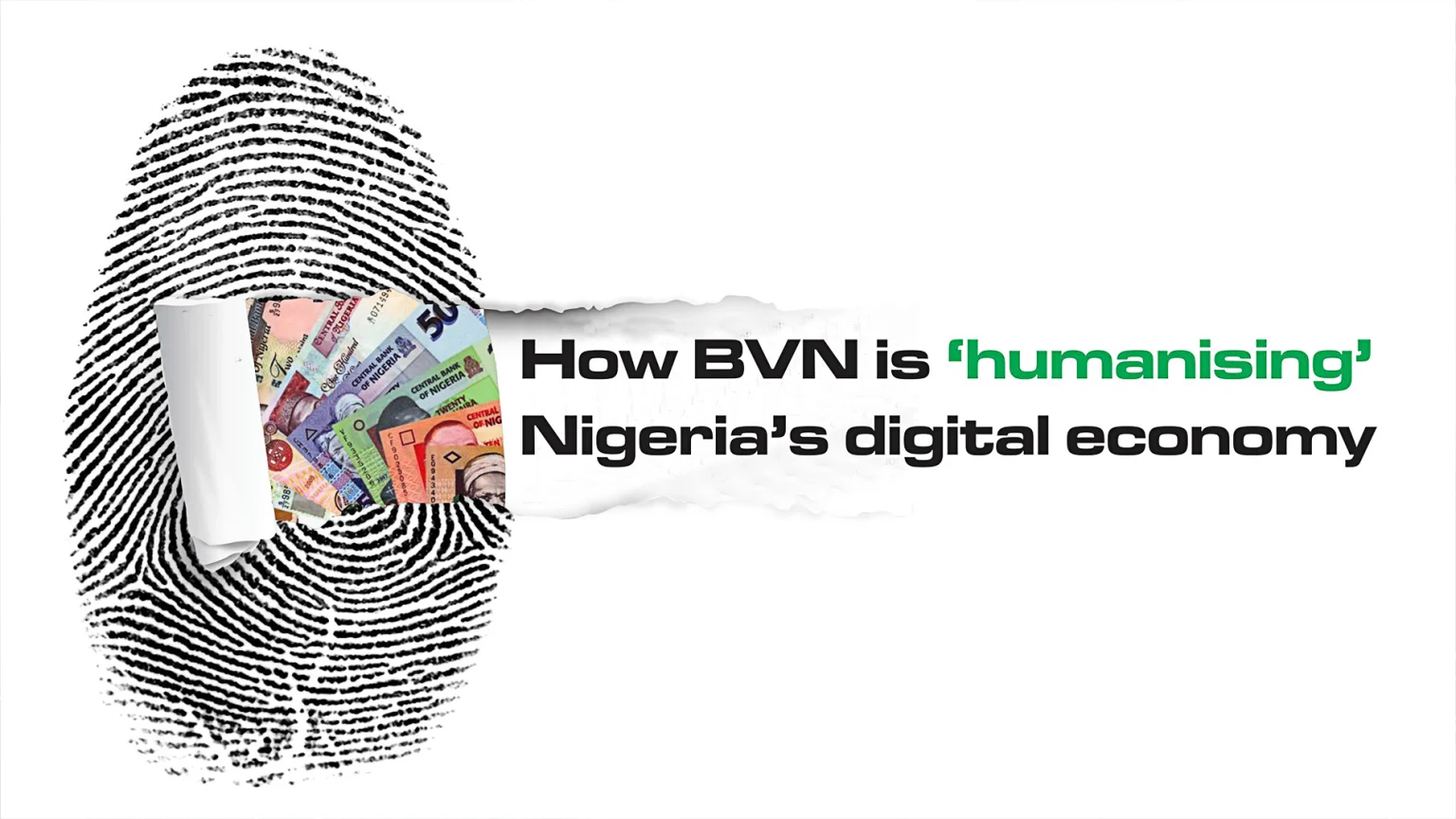
The Bank Verification Number (BVN) is more than a string of digits; it is the biometric pulse of Nigeria’s digital public infrastructure. By anchoring the payment layer to verified human imprints, the system moves financial transactions beyond anonymity to one defined by human visibility, thereby ensuring accountability and trust, ADEYEMI ADEPETUN writes.
For years, the Nigerian financial sector operated in fragmented silos. A borrower could default on a loan at one bank, walk into another, and with a clean slate and a different set of documents, secure a new line of credit. At the same time, identity theft and unauthorised access remained a persistent shadow over digital transactions, undermining public trust in the emerging digital economy.
The turning point arrived in 2014, when the Central Bank of Nigeria (CBN), in collaboration with the Nigeria Inter-Bank Settlement System (NIBSS), introduced the Bank Verification Number (BVN).
What began as a strategy to clean up bank records has evolved into something far more profound: a foundational Digital Public Infrastructure (DPI). By anchoring every financial identity to a unique, biometric-backed ‘digital fingerprint’, the BVN has done more than just streamline account opening; it has created a shared, interoperable layer of trust that spans the entire banking ecosystem.
Today, this infrastructure is the silent force behind two of the most significant shifts in Nigerian finance. First, it has armed institutions with the Global Standing Instruction (GSI), a powerful mechanism that allows for the automatic recovery of debts across different banks, helping to improve loan recovery. Second, it has strengthened the financial system’s defence against fraud by linking bank accounts to biometric identifiers such as fingerprints and facial data, making identity verification more robust and significantly raising the barrier against impersonation and identity spoofing in digital transactions.
The BVN is a key component of Nigeria’s DPI. As an “identity layer”, it has fundamentally reshaped the rules of the game, turning a simple 11-digit number into the bedrock of a more secure, accountable, and inclusive digital economy.
Before BVN era
BVN technology in Nigeria is not just about banking security; it is a foundational shift in how the nation interacts with its economy. The impact has been profound, moving the country from a cash-heavy, opaque financial environment to a transparent, digital-first, and inclusive ecosystem. It has helped in aggressive loan recovery.
A typical example is the recent push by the Federal Government to recover the N50 billion Targeted Credit Facility (TCF) released by the Central Bank of Nigeria in 2020 to cushion the adverse effects of COVID-19 on households and micro, small and medium enterprises (MSMEs).
Many beneficiaries did not fully understand the scheme they entered. Some beneficiaries claimed it was a grant, but NIRSAL Microfinance Bank (NMFB), through which the funds were disbursed, said it doesn’t give grants but loans.
The issue got complicated with the involvement of third parties, who actually got the supposed ‘grant’, which ranged from N500,000 to N1 million, but fraudulently disbursed between N300,000 and N720,000 to would-be final beneficiaries. According to NISRAL, the funds were supposed to be returned by 2023, but people refused, maintaining that it was a grant, not a loan.
This forced NISRAL to activate the GSI, which allows the BVN to locate wherever defaulters have money in their accounts and forcefully remove any available funds. Some affected beneficiaries woke up one day to see that as much as N950, 000 had been forcefully withdrawn from their accounts. Some people were debited twice. Others’ removal was in instalments.
Narrating her experience with The Guardian, Ebunoluwa Bolarinwa, a Lagos-based computer engineer, said she woke up one morning to discover that NIRSAL MFB had deducted N450, 000 from one of her bank accounts linked to her BVN.
“Immediately, I had to look for their location and went to complain, but I was told it was a loan and not a grant, which ought to have been repaid in 2023. It was a friend who was working with the CBN at the time who informed me about the ‘grant’. After pleading that they should not withdraw my money again, I had to move the remaining money in the account to my other account.
“But exactly five months after, N550, 250 were forcefully removed from my other account. I was shocked, almost ran mad because the money was supposed to be used to buy some goods for onward delivery to a client.”
Nnamdi Okonkwo, a furniture maker, was also caught in the web. He got N260, 340 as part of the COVID-19 intervention fund in December 2020, which he thought was a grant. He claimed that he did not sign any documents at the time, but only gave his account and BVN details to the facilitator. But in 2023, he found out that he would need to repay the ‘grant-turned-loan,’ after NISRAL sent him a text to begin repayment.
“I was not informed that it was a loan that we were given instead of a grant. I got N260, 340; an account was opened for me by the bank. We thought that it was a grant at that time. No message was sent to me until September 2023, stating that I was supposed to have paid the loan,” he said.
“I started the repayment in November 2023. I was paying about N35, 000 monthly, but along the line, a family member was sick, the concentration shifted to the sick person, which gulped so much, defaults set in, not meeting up. By November 2025, a cousin sent me N400, 000 from abroad. To my surprise, within four hours, my account was debited to the tune of N350, 000 by NISRAL MFB. I am still battling to recover the money from them, after they have deducted their loans from it.
The Guardian findings showed that deductions were done randomly based on the system’s algorithms and, especially in a funded account.
With the battle not over, almost daily, many people continued to throng NISRAL offices across the country. On February 5th and 9th, 2026, The Guardian visited the NISRAL Office located at the Post Office in Ikeja, and several affected people besieged the office for possible negotiations.
According to a security officer, James Osho (not real name) attached to the centre, “this has been the situation since the last quarter of 2025. They came in droves to demand an explanation for the sudden ‘disappearance’ of funds from their accounts.”
Impact on fraud, safety net schemes
Amid loan recovery, recent data from NIBSS showed that the push for tighter BVN-NIN (National Identification Number) linkage is yielding results.
For instance, digital payment fraud losses fell significantly from N52.26 billion in 2024 to N25.85 billion in 2025—a 51 per cent drop, according to NIBSS e-payment data. The total number of fraud cases dropped from over 123,000 in 2021 to approximately 67,515 in 2025. This suggests that while fraudsters are still trying, the “net” created by BVN is catching them much faster.
The BVN has been a game-changer for Nigeria’s financial security since its launch in 2014. By adding to passwords and PINs with unique biometric identifiers (fingerprints and facial features), it has created a “digital footprint” that fraudsters find increasingly difficult to outrun.
As a Safety Net, the BVN-NIN was deployed for the Presidential Conditional Grant Scheme (PCGS) – ‘Nano Grants’. This programme targeted one million nano-business owners across all 774 Local Government Areas (LGAs) with a one-time grant of N50, 000.
During the application phase, both BVN and NIN were mandatory fields. The Bank of Industry (BOI), which executes the scheme, uses this data to verify that the applicant’s business identity matches their financial records. It prevented a single individual from receiving multiple grants by linking their biometric identity (NIN) to their financial identity (BVN).
According to Public Affairs commentator, Segun Olugbile, who said the BVN has become the government’s safety net, stressed that it has been instrumental in helping to eliminate ‘ghost workers’ in the public sector.
He said, “One of the most significant impacts of BVN has been in the Nigerian Civil Service. Corrupt officials would create thousands of fake names (ghost workers) on government payrolls and collect their salaries.
“But by linking every bank account to a unique biometric identity, the government discovered individuals receiving multiple salaries across different banks. In 2016 alone, the Federal Government removed over 23,000 ghost workers from the payroll, saving billions of Naira monthly.”
The BVN numbers
The BVN has evolved into a cornerstone of the country’s financial digital infrastructure. By December 2025, the BVN database reached 67.8 million registrations, expanding significantly from 63.5 million in 2024 and 51.9 million in 2021.
This biometric identification system, managed by the NIBSS, has transitioned from a voluntary initiative to a mandatory requirement for securing financial assets, driving compliance through rigorous policy enforcement.
Key data and milestones in the last five years showed that in 2021, we had 51.9 million registrations; 2022, 56 million; 2023, 60.1 million; 2024, 63.5 million and December 2025, 67.8 million.
Checks by The Guardian showed that the surge in data, particularly in 2024 and 2025, was attributed to several key policy moves. This includes mandatory linking in 2024. There was a CBN directive in April 2024, which ordered banks to freeze accounts lacking a BVN or National Identification Number (NIN). This forced a massive influx of registrations.
The cashless economy push also gave a fillip to the BVN operations, which saw a rapid growth of digital transactions. For instance, Nigeria recorded in 2024, the ePayment value of N1.07 quadrillion. In Q1 2025, NIP transactions hit N284.9 trillion.
Speaking with The Guardian, the Group Managing Director/CEO of CRC Credit Bureau Limited, Dr Ahmed Babatunde Popoola, said the integration of the BVN with the GSI framework has had a measurable impact on reducing non-performing loans (NPLs) in the Nigerian banking sector. He said by linking the BVN to all accounts held by a borrower across Nigerian financial institutions, lenders can now enforce cross-bank recovery of overdue obligations with greater efficiency, stressing that this mechanism has significantly improved loan repayment discipline and reduced the incidence of strategic default, particularly in consumer lending, where identity verification and borrower tracking were historically weaker.
While it is not yet uhuru for the technology, the CRC Credit Bureau boss, revealed that the framework has also brought emerging legal and regulatory considerations to the fore. He said data privacy concerns have grown as customers question the scope of data sharing across institutions and the extent to which consent is obtained and managed.
As a functional DPI rail
Today, in the context of Nigeria’s DPI, the BVN increasingly functions as a foundational interoperability layer connecting the financial sector with broader elements of Nigeria’s DPI. Its use as a central identity anchor facilitates linkage with other key systems such as the NIN, tax databases, pension systems, and social services.
According to Popoola, this interoperability is enabling more efficient service delivery, improved compliance, and greater financial inclusion as citizens gain more seamless access to formal financial and government services.
He was, however, quick to say that the centralisation of identity data also presents potential systemic risks. According to him, any disruption, whether technical, cybersecurity-related, or administrative, could affect multiple sectors simultaneously. He said a major outage or security breach involving the BVN database could have cascading implications across banking, payments, government services, and identity verification processes.
Providing more insights, Fintech Expert, David Dickson, said in the context of Nigeria’s DPI, the BVN acts as a layer for both Identity and Payment. He said by linking the BVN to these layers, the government transitions from a “siloed” system to an integrated ecosystem that enhances digital governance.
“The identity layer is the ‘Who are you?’ of DPI. While the NIN is the primary unique identifier for all citizens, the BVN provides a high-fidelity biometric anchor specifically for the financial sector.
“In 2025, Nigeria mandated the linkage of BVN and NIN to create a single source of truth. This allows the National Identity Management Commission (NIMC) and the Nigeria Inter-Bank Settlement System (NIBSS) to synchronise records.”
On her part, Head of Corporate Communications, NIBSS, Lilian Phido, said the BVN-NIN linkage is a pivotal step in strengthening Nigeria’s DPI.
She said it marks the transition of the BVN from a narrowly defined banking identifier into a broader, trusted, functional identity layer that can enable inclusive social and economic participation.
This report is produced under the DPI Africa Journalism Fellowship Programme of the Media Foundation for West Africa and Co-Develop.
According to her, overall, this linkage will deliver faster on boarding into financial services, more accurate and transparent G2P disbursements, improved credit inclusion through verified identity, and reduced fraud across public and private systems.
“The linkage is not just a compliance exercise but a foundational building block in Nigeria’s DPI journey. Allowing the BVN to complement the NIN with a high-assurance financial identity layer that powers economic participation is important. Our responsibility at NIBSS is to ensure that as interoperability increases, trust increases proportionally. This is because at scale, trust and not just technology is what makes DPI sustainable.”
She stressed that it is critical that as BVN becomes more functionally relevant across sectors, the underlying architecture must be resilient, auditable, and defensible.
This report is produced under the DPI Africa Journalism Fellowship Programme of the Media Foundation for West Africa and Co-Develop.